
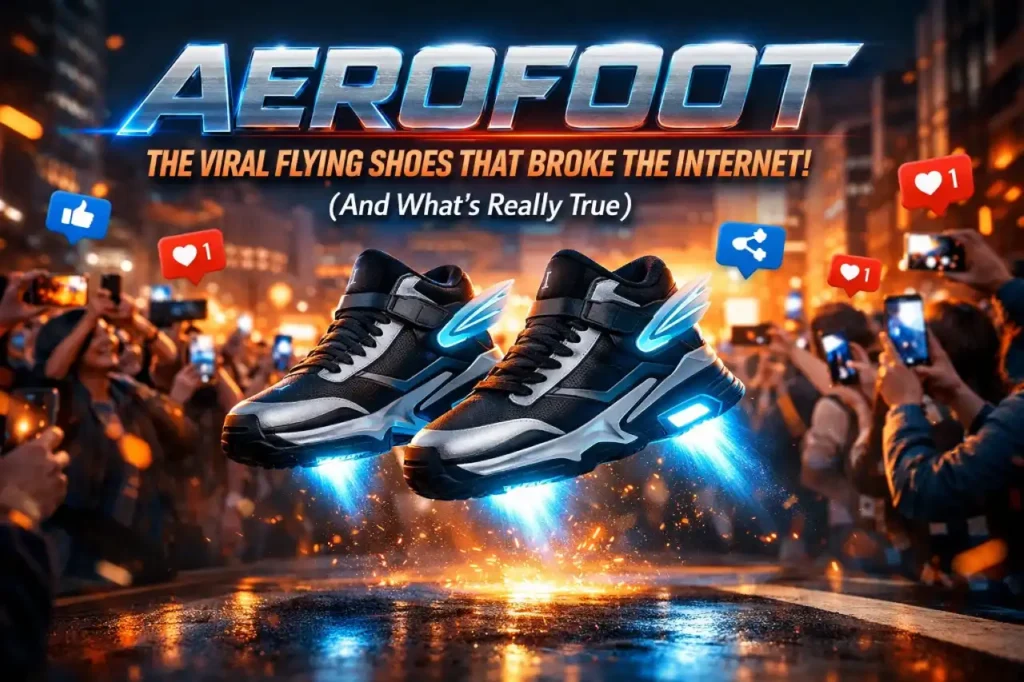
Featured Snippet: Aerofoot is a fictional concept of AI-generated flying shoes that went viral in October 2025. The videos, created by Dubai-based digital artist Jyo John Mulloor, show people hovering above the ground wearing futuristic footwear. They are not real. No such product exists. AI detection tools confirmed the footage with 99.9% certainty as computer-generated content.
Imagine slipping on a pair of sleek sneakers and lifting off the ground. No wings, no drone, no cables. Just you, a pair of shoes, and open air beneath your feet. That is exactly what millions of people thought they were watching when videos of Aerofoot exploded across social media in late October 2025. The clips racked up hundreds of thousands of likes within days. Comment sections buzzed with disbelief, excitement, and one question on everyone’s mind: is this real?
The short answer is no. But the full story is more interesting than a simple fact-check. The Aerofoot phenomenon sits at the sharp edge of a growing problem: AI-generated content so polished, so convincing, and so perfectly packaged that it passes for reality. Understanding what happened here tells you something important about where media, technology, and human curiosity are headed.
This article breaks down what Aerofoot actually is, who made it, how the deception spread so fast, what real personal flight technology looks like today, and why this moment matters far beyond a pair of fake shoes.
What Is Aerofoot?
Several videos of flying shoes, branded as Aerofoot, went viral across social media platforms on October 21, 2025. The original clips show a young man standing on a small podium wearing something resembling skating shoes. Seconds later, he rises about two feet into the air, spins, and lands. The setting appears to be a tech exhibition, with attendees in traditional Emirati kanduras cheering as the shoes are showcased.
The branding was sharp. The captions read “Aerofoot: Future in Motion” and referenced GITEX 2029, one of the world’s biggest technology expos, held annually in Dubai. A second video showed models in black semi-formal attire floating down a runway. A third featured a woman in formal wear stepping backward while elevating herself from the floor.
The visuals were striking: minimalist design, muted lighting, and an understated logo that read simply “Aerofoot.” Within days, reposts flooded timelines. Comment sections filled with disbelief and curiosity. Viewers debated whether the shoes were magnetic, drone-powered, or computer-generated.
The answer turned out to be none of the above. They were pure AI fiction.
Who Made the Aerofoot Videos?
The individual behind the Aerofoot videos is Jyo John Mulloor, a digital artist based in Dubai who founded JJM AI Studio. His studio is described as a visionary digital art operation that specializes in AI-powered creations and pushes the boundaries of modern storytelling.
Mulloor labels himself an “AI Time Traveller” on his social media profiles. His creative work frequently imagines speculative futures, presenting them with the visual language of product launches and live demos. When investigators traced the videos back to him, he confirmed: “Yes, the Aerofoot Demo video was created by me. Aerofoot is purely a fictional, conceptual creation.”
That confirmation closed the case. But by then, the content had already spread globally.
How Did So Many People Believe It?
This is the part worth studying carefully.
The branding, paired with the futuristic backdrop of a high-profile tech event, lent the spectacle a convincing sense of authenticity. The presentation was complete with digital banners and sleek promotional styling, implying that Aerofoot represented the next step in personal flight technology.
Three factors made the deception work:
First, the production quality. Modern AI video tools can generate photorealistic textures, simulate physics, and render believable human movement. The Aerofoot clips did not look like amateur edits. They looked like brand content.
Second, the setting. Placing the concept at GITEX, a real and respected tech event, added a layer of institutional credibility. Viewers familiar with how product launches work at expos saw familiar visual signals: crowds, spotlights, a branded backdrop, and an official-looking presenter.
Third, the timing. The video’s claim of a 2029 expo date adds a layer of irony, as GITEX 2025 had just concluded, highlighting the rapid pace of technological speculation versus actual development. People were already thinking about tech announcements. The context felt plausible.
What the Fact-Checkers Found
Multiple organizations investigated the videos within days of their publication.
An AI detection tool determined with 99.9% likelihood that the videos contained AI-generated or deepfake content. The creator, Jyo John Mulloor, described as a Digital Artist and AI Enthusiast, posted similar glitchy AI-generated footage across his social media profiles.
Several tech experts and users on LinkedIn confirmed that the clips were 100% AI-generated, not actual demo footage. There has been no official announcement from GITEX Dubai or any company about launching hover shoes named Aerofoot.
Here is a summary of what investigators found:
| Claim | Verdict |
|---|---|
| Aerofoot is a real product | False |
| GITEX 2029 hosted a flying shoe demo | False |
| Videos were filmed at an actual event | False |
| AI detection confirmed fake content | True (99.9% certainty) |
| Creator admitted it is fictional | True |
| Any prototype or patent filed | No evidence found |
Is Flying Shoe Technology Even Possible?
What Real Hovering Tech Can Do Today
This is where the conversation gets genuinely interesting. Dismissing Aerofoot as fake does not mean personal flight devices are impossible. They just do not look like clean sneakers yet.
Engineers have demonstrated hovering skateboards using superconductive materials and rail-guided magnetic systems. The Hendo Hoverboard, for example, used magnetic field architecture to hover about an inch above a copper surface. Franky Zapata crossed the English Channel in 2019 on a jet-powered flyboard. VTOL (vertical takeoff and landing) personal mobility devices have attracted billions in investment from companies including Boeing, Joby Aviation, and Archer.
Why Aerofoot’s Look Is Still Science Fiction
The small, boot-sized form factor seen in the video provides no plausible mechanism for the necessary propulsion system, battery capacity, or stabilization hardware. No visible signs of exhaust, rotor systems, or tethered support structures appear in the clips.
The physics are brutal. Lifting a 70 kg human vertically requires sustained thrust that current battery technology simply cannot deliver in a shoe-sized package. Jet turbines generate that power, but they need fuel and space. Electromagnets can hover objects, but only above specially prepared conductive surfaces. None of that is portable yet.
How Far Are We From Real Flight Shoes?
Most aerospace engineers put wearable personal levitation at least 15 to 20 years away under current technology trajectories. Battery energy density needs to increase roughly ten times from its current level. Materials science needs to provide lighter structural components. Stabilization algorithms need to manage micro-corrections fast enough to prevent injury.
Real flight shoes are not impossible. They are just not here.
Why Aerofoot Matters Beyond the Hoax
Artificial intelligence now sits at the intersection of imagination and engineering. The Aerofoot case highlights how advanced AI tools, particularly generative visual systems, are reshaping our understanding of authenticity. What once required costly production studios or physical prototypes can now be achieved through algorithms that render photorealistic textures, physics simulations, and believable human movement.
This creates a real problem. When a creative artist produces something as polished as the Aerofoot videos, there is no reliable visual cue that tells you “this is fiction.” The old signals we used to trust, such as grainy footage, obvious edits, or unnatural movement, no longer apply. A skilled AI artist can now produce product-quality video with no physical product at all.
The hoax aligns with a growing trend of AI-generated fakes. Social media reactions ranged from excitement about future possibilities to frustration with AI clutter, reflecting broader concerns about misinformation in the digital age.
The lesson is not that AI art is harmful. Mulloor’s work is genuinely impressive, and his intent was artistic rather than malicious. The lesson is that your default assumption when watching viral tech content needs to shift. Ask yourself: Is there a company behind this? Is there a patent? Has any credible tech journalist covered the actual product? If the answer to all three is no, slow down before sharing.
FAQs About Aerofoot
Is Aerofoot a real product you can buy? No. Aerofoot does not exist as a physical product. There are no patent filings, no company, and no commercial prototype. The name and visuals were created entirely as AI-generated conceptual art.
Who created the Aerofoot videos? Jyo John Mulloor, a Dubai-based digital artist from India, created the videos using AI tools through his studio, JJM AI Studio. He confirmed this himself after the videos were investigated.
Did Aerofoot appear at GITEX 2025 or 2029? No. GITEX 2029 has not occurred. The videos used a fictional future event as a backdrop. GITEX 2025 took place in October 2025 with no Aerofoot demonstration of any kind.
Could flying shoes ever be real? In theory, yes. But current battery, propulsion, and stabilization technology cannot fit into a shoe-sized device. Engineers estimate meaningful personal levitation wearables are at least 15 to 20 years away.
How can I spot AI-generated tech videos in the future? Look for odd text in the background, unnatural finger or hand rendering, and missing physical evidence like company websites, press releases, or engineer interviews. Use AI detection tools like Hive when uncertain.
The Bigger Picture
The Aerofoot story is a reminder that human curiosity and the desire for flight are powerful forces. People wanted the shoes to be real. That desire, combined with AI tools that can now produce broadcast-quality fiction, created the perfect conditions for a global viral moment built on nothing.
Jyo John Mulloor is a talented artist. His videos are impressive precisely because they tap into something deep: the centuries-old dream of unaided human flight. But his work also exposed something uncomfortable. Millions of people worldwide shared, liked, and debated footage that an AI detection tool flagged as fake with near-total certainty. That gap between perception and reality is the real story here.
The next time a product breaks the internet with impossible-seeming capabilities, take thirty seconds before you share it. Check for a company. Search for the engineer. Look for the physics. The dream of flying shoes will one day be worth celebrating. That day just has not come yet. When it does, it will arrive with patents, press conferences, and a CFO answering questions about unit economics, not as a thirty-second clip captioned “Future in Motion.”
