
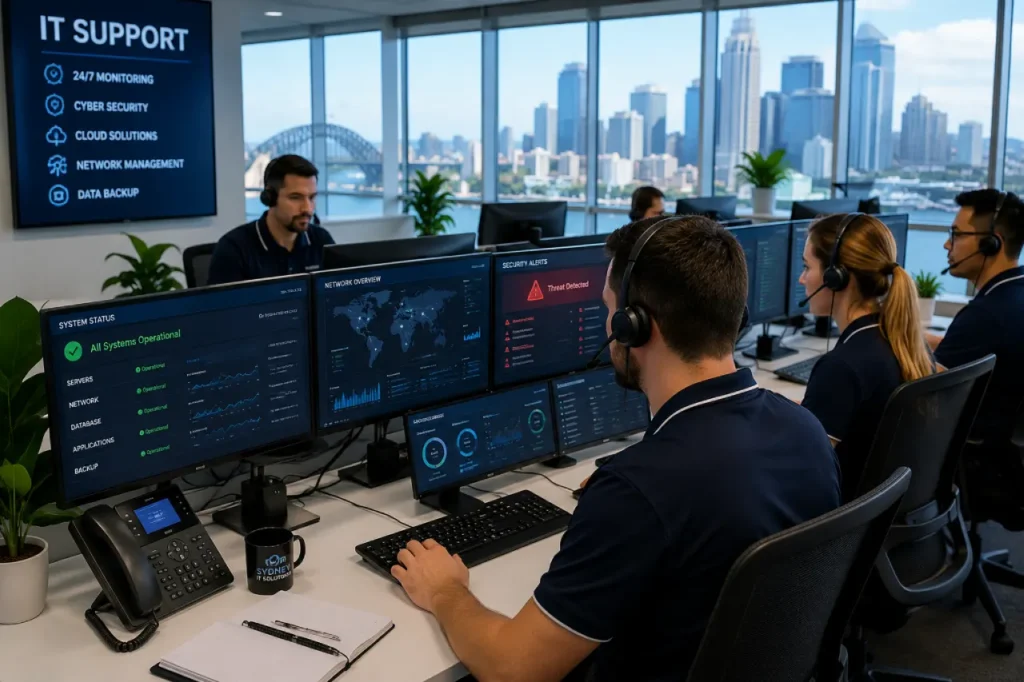
Sydney businesses lost more hours to IT outages last year than most owners want to admit. A single ransomware email, one failed backup, or a server that quietly dies on a Friday afternoon can cost weeks of recovery time. That’s the exact gap a managed service provider in Sydney is built to close. Instead of waiting for something to break, a good provider watches your systems around the clock and fixes small problems before they turn into expensive ones.
The Australian managed services market has grown past $18 billion and keeps climbing at nearly 8% a year. Sydney sits at the center of that growth, with major business hubs including Sydney CBD, North Sydney, Parramatta, Macquarie Park, and Western Sydney. These areas are home to thousands of finance firms, healthcare providers, law practices, manufacturers, and fast-growing technology companies that depend on reliable managed IT services. If you’re hunting for the right IT partner, you’re competing against thousands of other business owners asking the same question: which provider actually delivers?
This guide breaks down what a managed service provider in Sydney does, what it should cost, and how to separate a genuine IT partner from a glorified help desk. You’ll find a pricing comparison, a checklist for vetting candidates, and answers to the questions Sydney business owners ask most. By the end, you’ll know exactly what to look for before you sign a contract.
What a Managed Service Provider Does

A managed service provider (MSP) takes over the day-to-day running of your business technology. That covers your network, devices, cloud accounts, backups, and security tools. Instead of hiring a full internal IT team, you pay a monthly fee and the MSP handles support tickets, monitoring, and maintenance.
Managed service provider in Sydney: a third-party company that monitors, maintains, and secures a business’s IT systems under a fixed monthly contract, covering help desk support, cybersecurity, cloud management, and backup and disaster recovery.
Core Services You Should Expect
Most reputable MSPs bundle these services as standard:
- 24/7 monitoring of servers, networks, and endpoints
- Help desk support with guaranteed response times
- Cybersecurity, including endpoint protection and threat detection
- Cloud management for Microsoft 365, Google Workspace, or AWS
- Backup and disaster recovery with tested restore points
- Compliance support for frameworks like the Essential Eight or APRA CPS 234
If a provider skips security or backups from their base package, treat that as a warning sign. Security expert Vaughn Riordan, a Sydney-based IT consultant, put it plainly in a recent industry panel: businesses that treat cybersecurity as optional are gambling with their entire operation.
Why Sydney Businesses Are Switching to MSPs
The shift toward outsourced IT isn’t simply a trend for Sydney businesses. It’s a practical response to rising cybersecurity risks, growing compliance requirements, and the increasing cost of maintaining an in-house IT team. From financial firms in Sydney CBD to healthcare clinics in Parramatta and professional service businesses across North Sydney, organisations are relying on managed service providers to keep their systems secure and available around the clock.
Hiring experienced IT professionals has also become more expensive. A single senior IT engineer in Sydney can cost well over $110,000 per year before superannuation, training, and software licensing. For a similar investment, many small and mid-sized businesses can access an entire team of specialists through an MSP, including cybersecurity experts, cloud engineers, and network administrators.
Local knowledge also matters. A Sydney-based managed service provider understands the needs of businesses operating across areas such as Western Sydney, the Inner West, and the Sydney CBD. They can provide faster onsite support when required while helping businesses meet Australian security frameworks such as the Essential Eight and industry compliance requirements.
Managed Service Provider in Sydney: Cost Breakdown

Pricing varies by business size, industry, and service scope. Here’s a general guide for what Sydney SMBs typically pay per user, per month, as of 2026:
| Business Size | Basic Support Only | Full Managed IT + Security | Enterprise-Grade with Compliance |
|---|---|---|---|
| 1-20 staff | $80-$120 | $130-$180 | $200+ |
| 21-50 staff | $70-$100 | $110-$160 | $180+ |
| 51-100+ staff | $60-$90 | $95-$140 | $160+ |
These figures shift based on how much legacy infrastructure you have, whether you need after-hours support, and your compliance obligations. A law firm handling client trust accounts will pay more than a retail shop with basic point-of-sale needs, simply because the security and audit requirements differ.
Always ask for a breakdown of what’s included versus billed as an extra. Some providers quote a low base rate, then charge separately for backups, security patches, or after-hours callouts. That structure can double your real monthly cost.
Different parts of Sydney often have different IT requirements. Businesses in Sydney CBD and North Sydney usually prioritise cybersecurity, Microsoft 365 management, and compliance because they work in finance and professional services. Companies in Western Sydney may require stronger network infrastructure, warehouse connectivity, and multi-site support, while healthcare providers in Parramatta often focus on secure patient data management and reliable backup solutions.
How to Choose the Right MSP for Your Business
Picking a provider is less about finding the biggest name and more about finding the right fit. A firm built for enterprise clients with 500 seats may treat a 15-person business as an afterthought. Look for a provider whose typical client size matches yours.
Red Flags to Watch For
Walk away if a provider shows any of these signs during your first conversation:
- Vague or unwritten service level agreements (SLAs)
- No clear escalation process for urgent issues
- Reluctance to explain their backup testing process
- Long-term lock-in contracts with steep exit penalties
- No local Sydney-based support team
Questions to Ask Before Signing
Before you commit, ask each candidate:
- What’s your guaranteed response time for critical issues?
- How often do you test backup restores, not just backup completion?
- Can you provide references from businesses in my industry?
- What happens if we want to switch providers later?
- Is your security stack aligned with the Essential Eight?
A provider that answers these clearly, without vague marketing language, is usually the one worth trusting with your systems.
In-House IT vs Managed Service Provider
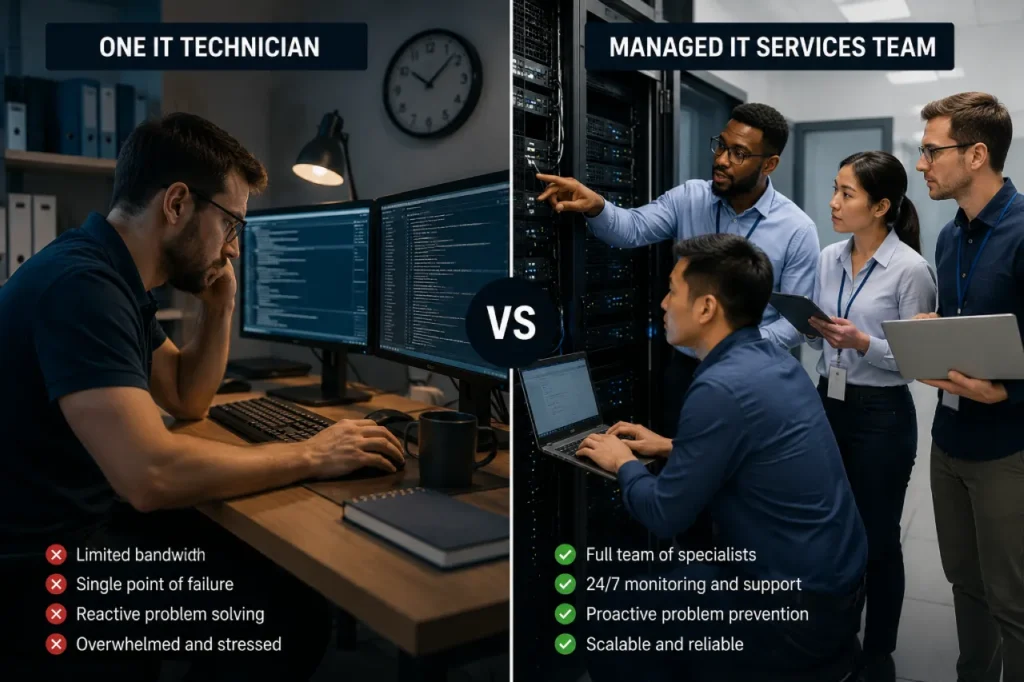
Both models work, but they suit different businesses. In-house IT gives you direct control and staff who know your systems intimately. It also means covering salaries, training, sick leave, and the risk of losing your only IT person to a competitor.
A managed service provider in Sydney spreads that risk across a full team. You’re never dependent on one person’s availability, and you gain access to specialists you likely couldn’t afford to hire individually. The tradeoff is less day-to-day control and a need to build trust with an external partner.
Many growing Sydney businesses now choose a hybrid IT model. Companies in areas such as Sydney CBD, Macquarie Park, Parramatta, and the Hills District often keep one internal IT coordinator for day-to-day support while relying on a managed service provider for cybersecurity, cloud infrastructure, network monitoring, and after-hours assistance. This approach gives businesses access to enterprise-level expertise without the cost of building a large in-house IT department.
Featured Snippet Summary
A managed service provider in Sydney is an outsourced IT company that monitors, maintains, and secures business technology under a monthly contract. Services typically include help desk support, cybersecurity, cloud management, and backup recovery, letting businesses access enterprise-level IT expertise without hiring a full internal team.
FAQs
How much does a managed service provider in Sydney cost?
Pricing runs roughly $60 to $200+ per user monthly, depending on business size, service scope, and compliance needs. Full security coverage sits at the higher end.
What’s the difference between managed IT and break-fix support?
Break-fix means paying per incident after something breaks. Managed IT is proactive, monitoring systems continuously to prevent issues before they cause downtime.
Do small businesses really need a managed service provider?
Yes. Small businesses are common cyberattack targets and often lack dedicated security staff, making outsourced monitoring and protection genuinely valuable.
How long are typical MSP contracts?
Contracts range from month-to-month to 12 or 24 months. Avoid long lock-ins unless the provider offers strong guarantees and proven reliability.
Can I switch MSPs without losing data?
Yes, if your current provider maintains proper documentation and backups. Always confirm data portability terms before signing with any new provider.
Final Thoughts
Choosing a managed service provider in Sydney comes down to matching your business size, budget, and risk tolerance with a provider that actually delivers on its promises. The cheapest option rarely wins long term, especially once you factor in downtime costs and security gaps. Focus on response times, transparent pricing, and a security-first approach before anything else.
Take your time during the evaluation process. Ask direct questions, check references, and read the contract terms closely before committing. The right partner won’t just fix problems when they happen. They’ll help you avoid most of them in the first place, giving your team more time to focus on running the business instead of babysitting the network.
