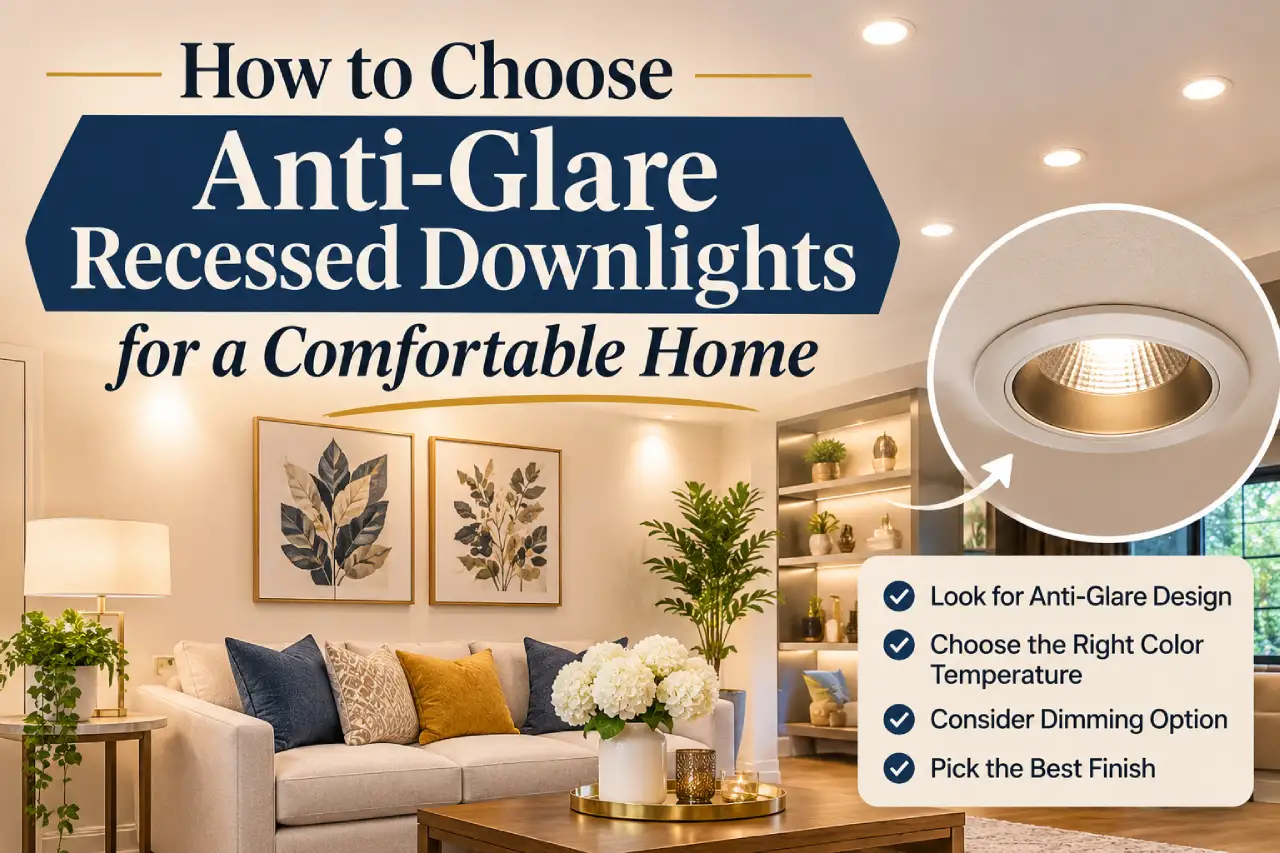
A comfortable home is not simply a bright one. You notice this most in the evening, when you sit down, the room darkens around you, and a ring of light in the ceiling suddenly feels sharper than it did in the afternoon. The room may have plenty of light. The problem is that your eyes keep meeting the source of it. Choosing an anti-glare recessed downlight is really about that moment: whether the fitting disappears into the ceiling, or whether it keeps announcing itself across the room.
Comfort is about what sits in your line of sight
Your eyes do not experience a downlight the way a floor plan does. A fitting that looks neat in a photograph can still sit in your field of view once you are on the sofa or at the dining table.
Standing under a light is one test. Sitting is a better one. From a chair, you look across the room at a shallower angle, and a shallow, bright fitting becomes a small disc of glare. The same thing happens in a hallway, where you walk towards the lights, and in a living room where a television or a glass table reflects whatever is in the ceiling. Comfort comes from putting light on the surfaces you use, while keeping the bright source itself out of everyday view.
How a fitting hides the light source
Recessed downlights manage glare by changing what you see when you look towards the ceiling, not by simply lowering the output.
Recess and shielding
In a more comfortable fitting, the LED is set back from the ceiling line. From a normal viewing angle you mainly see a dark or softly lit opening, rather than the chip itself. A deep reflector, a baffle or a honeycomb shield each interrupts that direct view. A shallow fitting with a wide, bright face does the opposite: it can put plenty of light into the room, but also into your eyes. If you are comparing two similar sizes, the one that hides the source more deeply is usually the more comfortable choice in a living space.
Beam and spread
The beam is the shape of the light once it leaves the fitting. A tighter, more controlled beam — often in the region of 24 to 40 degrees — puts light on a table or a bench and leaves the surrounding ceiling quieter. A wide flood covers more floor with fewer points, but it is also easier to see from the side. Living and dining areas usually feel calmer with a more controlled beam and fewer, well-placed points. Work surfaces can take a tighter beam aimed at the bench, not at the person standing there.
Choosing by the way you use each room
It helps to shop with a short list of rooms, not with one favourite fitting you hope will do everywhere.
In living and dining areas, start with sitting height. Avoid a downlight that will sit in someone’s eyeline or reflect in the television. A smaller number of well-shielded fittings, on a dimmer, almost always feels better than a tight grid at full output.
In bedrooms, a downlight directly above a pillow is tiring to read under and harsh if you look up. Place lights for dressing and general use, and keep them dimmable so the room can change between early morning and late evening.
In kitchens and at a desk, place the fitting slightly in front of the person working, so the light lands on the bench or the page rather than on the back of their head. Glossy benchtops and screens reflect glare just as readily as a television does. Wet rooms need a fitting with a suitable IP rating for its location, which your licensed electrician should confirm.
What to look for before you buy
Once you know how each room should feel, ignore the styling photograph for a moment and check the ceiling cut-out, the depth the fitting needs above the plasterboard, the beam, whether it is dimmable, and the colour temperature.
Colour temperature is the warmth of the white light, measured in kelvin. A warm white around 2700 K to 3000 K is a comfortable default in living areas and bedrooms. A slightly cooler 4000 K can help at a bench, but mixed colours in one open-plan space often look accidental. If rooms connect, choose one colour and stay with it.
You may also see a UGR figure, or Unified Glare Rating, on a datasheet. It is a calculated value for a particular room and layout, not a promise that the same fitting will feel the same in your home. Treat it as a clue that glare has been considered, then still look at how deeply the source is recessed and how the beam is shaped. If you want a clear view of how recessed optics, shields and beam options are typically arranged, a practical overview of anti-glare downlights is a useful place to compare those details before you shortlist a model.
Dimming is worth specifying even if you want the room bright. A compatible dimmer, matched to the driver, lets the same ceiling work at dinner and later in the evening. Ask your electrician to specify one that suits the new lights; an old dimmer is a common cause of flicker.
Mistakes that undo a careful choice
A few habits quietly put glare back into a room: choosing by wattage or price alone; using one wide-beam fitting throughout the house, including over the sofa; forgetting to check the space above the ceiling; and leaving colour and dimming until the lights have already been bought. The most useful check is still the simplest. If the plasterboard is in but the holes have not been cut, look up from the places you will actually sit or stand. If a point sits in your eyes, move it.
A short brief for your electrician
Write down how each room is used, whether the lights should be dimmable, the colour you prefer, and any wet areas that will need a suitable IP rating. Note existing hole sizes if you are replacing lights, and ask how much depth is available for the fitting and any separate driver.
Electrical work in a home must be carried out by a licensed electrician, who will also confirm that the fittings are suitable for each location. Your part is to be clear about comfort: shielded sources, light on the surfaces you use, and a ceiling you can look across without squinting. Keep that brief in mind, and you are more likely to end up with lights you stop noticing — which, in a comfortable home, is the point.
Author bio
Luke Huang is General Manager of A-ONE LED Lighting Co., Ltd., an OEM and ODM manufacturer of LED downlights and commercial lighting based in Dongguan, China. The company was founded in 2008 and operates a factory of about 6,000 square metres with around 150 staff.